TRANSMISSION GALLERY
  • Exhibitions
    • Ellen Bepp: The Ghosts We Carry
    • William Rhodes: Fear Not
    • Peter d'Agostino: World Wide Walks / SFBay
    • Gallery Showroom
    • Past Exhibitions Oakland
      • Donald (Aldo) Farnsworth: Hands of the Maker
      • Daniel McClain: Lost and Found
      • Cate White: World Raw
      • M. Mark Bauer: THE, THE
      • Jeff Dikio: This Must Be the Place
  • Events
  • News
    • Satellite Projects
  • Collect Art Online
    • Painting
    • Drawings
    • Prints
    • Sculpture
  • Artist's Opportunities
  • Artists
    • Robin L. Bernstein
    • Karl X. Hauser
    • William Rhodes
    • Sachiko Miki
    • Jeannie O'Connor
    • Dave Yoas
  • Contact
  • Visit
  • Exhibitions
    • Ellen Bepp: The Ghosts We Carry
    • William Rhodes: Fear Not
    • Peter d'Agostino: World Wide Walks / SFBay
    • Gallery Showroom
    • Past Exhibitions Oakland
      • Donald (Aldo) Farnsworth: Hands of the Maker
      • Daniel McClain: Lost and Found
      • Cate White: World Raw
      • M. Mark Bauer: THE, THE
      • Jeff Dikio: This Must Be the Place
  • Events
  • News
    • Satellite Projects
  • Collect Art Online
    • Painting
    • Drawings
    • Prints
    • Sculpture
  • Artist's Opportunities
  • Artists
    • Robin L. Bernstein
    • Karl X. Hauser
    • William Rhodes
    • Sachiko Miki
    • Jeannie O'Connor
    • Dave Yoas
  • Contact
  • Visit
Search
Featured exhibition now in the North Gallery:
painting of the cover of paperback book, The Psychology of Perception, with a replicated child's letter to their dad, chalkboard with lines, illustration of Pinocchio with an extra long nose, tracing of VanGogh's Starry Night and a page depicting how to draw a butterfly
Ellen Bepp, Sumi Bepp 2026, carved wood paint and neon, 48 x 22 x 18

ELLEN BEPP
​The Ghosts We Carry

September 24 - November 7, 2026 
​​​
Artist's Reception
Saturday, September 26th from 1-4 pm

Artist's Talk
Saturday, Oct 31st starting at 2 pm


Addressing ideas of identity, cultural preservation and social justice, Ellen Bepp’s mixed media work in The Ghosts We Carry reflects on the experience and legacy of a difficult period in our American history, WWII incarceration camps and their aftermath with a keen awareness of current events.

More than 120,000 people of Japanese descent were remanded to these camps in a wave of fear that swept America in response to attacks on Pearl Harbor, including Heart Mountain in Wyoming, where Bepp’s family was incarcerated.​

Incorporating fragments of familial writing, traditional textiles, imbedded text and Japanese imagery, Bepp’s work reflects on the xenophobia, racial slurs and casual taunts aimed at Asian Americans as well as the pain and despair of the camps. Beyond the fear and loss, emerges the powerful story of resilience and perseverance that sustained detainees through their experience and in resuming their place as autonomous citizens. A thoughtful examination of the work, standing with the elemental history of the objects and absorbing the words, honors that journey.

Looking ahead, mark your calendar for Ellen Bepp’s Artist’s Talk, Saturday, October 31st staring at 2 pm.
​Ellen Bepp Exhibition Statement
​

This work was created to shed light on the US government’s World War II incarceration of over 120,000 people of Japanese descent. Deeply impacted by my own family’s incarceration, I honor a few of my family members who were imprisoned and encourage dialog to connect the dots between that history and the current wave of racial hysteria, unlawful arrests, mass detention, deportations and killings. I attempt to amplify the message of resilience by connecting it to broader issues of social injustice perpetuated in today’s world.

Ellen Bepp Regarding the Work:
​

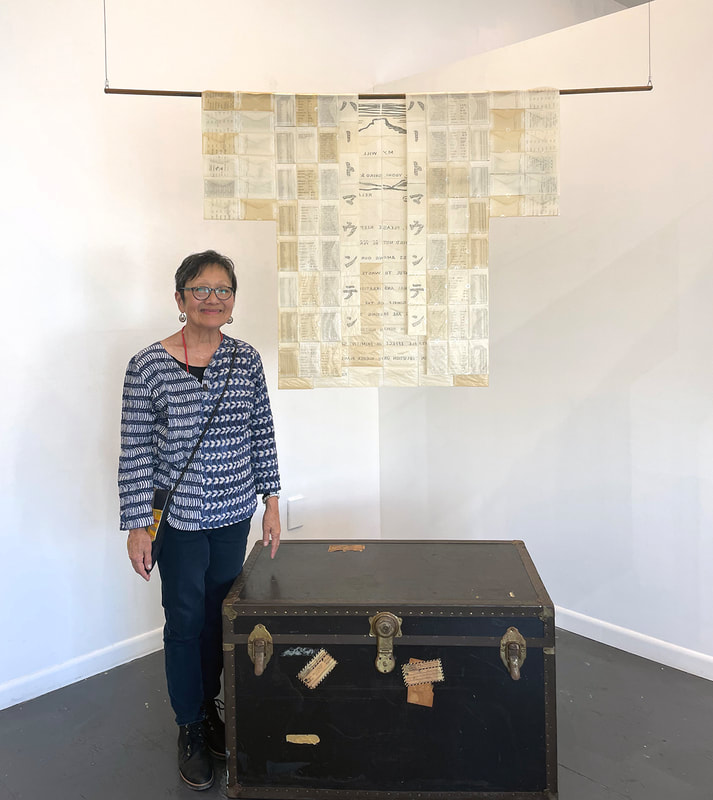
1. Heart Mountain Happi, 1999, 35 x 42.5, glassine envelopes, mylar, reinforcement labels    

This happi form is a reference to a hollow shell that normally holds life, assembled from glassine envelopes and photocopied transparency inserts, honoring my late paternal grandfather Kiroku Bepp. It suggests haunting memories, reflecting loss and emptiness. On the back is a drawing of Heart Mountain, barracks, barbed wire and the text of Kiroku’s Last Will written while he was imprisoned. The front envelopes contain pages from his notebooks from the early 1940s – ruminations about his life and the world situation, a glossary of English terms he had learned such as bleak, amnesty, fission, crony, lethal, idiot, vindicate, expedient, to name a few.
Other notes taken from the Readers’ Digest, Feb ’43, with the numbers of Jews killed from various countries: Poland = 3,000,000, Rumania = 900,000, Germany = 900,000, Hungary = 750,000, Czechoslovakia = 400,000, France, Holland, Belgium = 400,000, Russia = 3,000,000

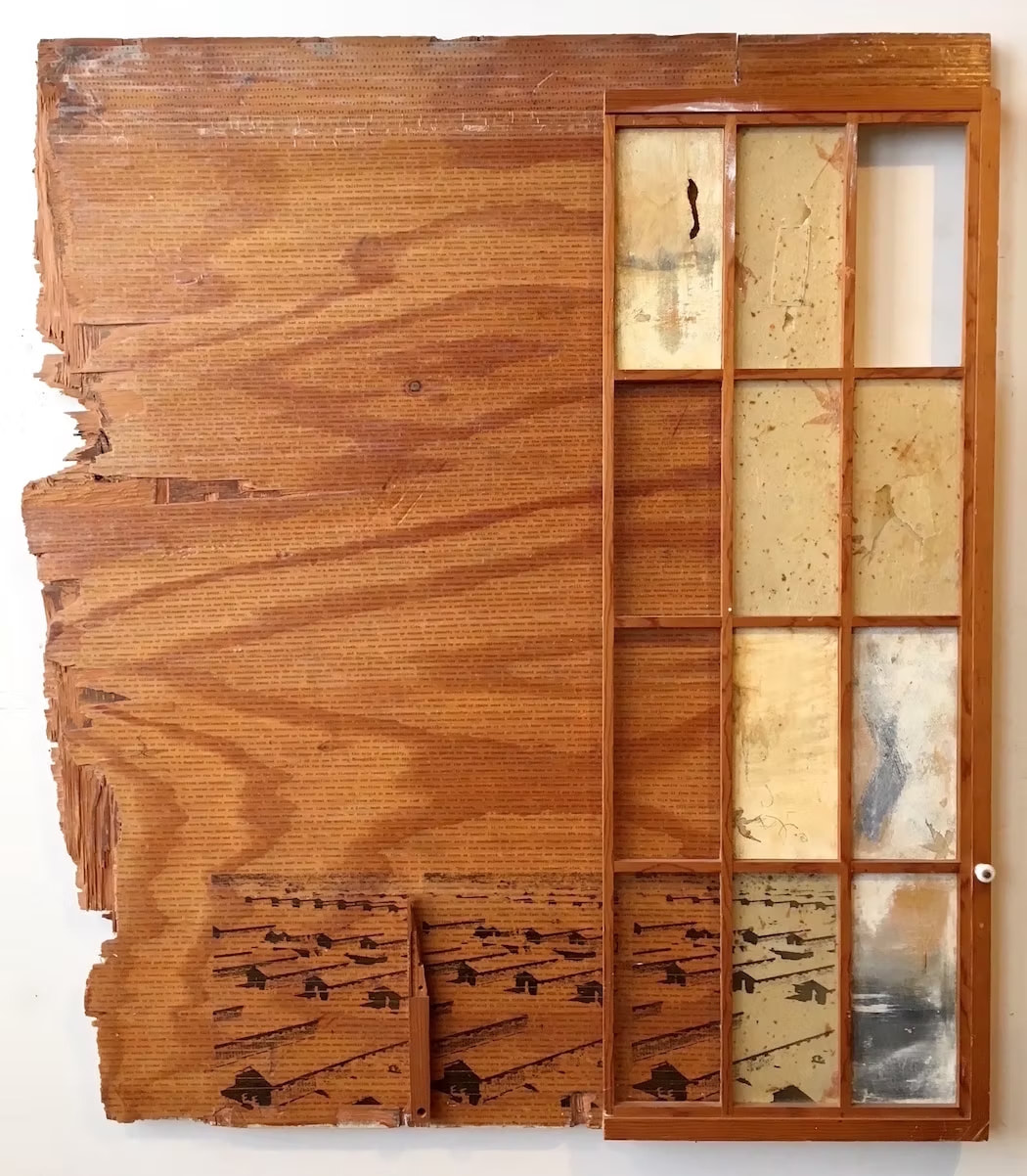
2. The Writing on The Wall, 1994, mixed media on upcycled wood panel, 43.5 x 36       

This piece is a combination of fragments out of the past – the remains of an Asian-style shoji panel, a weathered chunk of a wall with continuous lines of text: racist quotes from early history books describing anti-Asian hatred and xenophobia in America, poems of despair by Chinese immigrants carved into the cell walls at Angel Island Detention Station and quotes describing traumatic experiences of racism in the U.S. In the background loom images of rows of barracks at a WWII American concentration camp, and another reminder to heed the “writing on the wall”.

3. Scarred, 2019, hand cut paper on poster and foamboard, 23.5 x 13 

From March - Oct of 1942, 108 exclusion orders had been issued under the authority of Executive Order 9066 of the US government, signed by President Roosevelt. Posters like these were posted around towns, informing Japanese American residents of the impending mass removal. By the end of October 1942, all exclusion orders had been issued, forcing over 120, 000 Japanese Americans into concentration camps. I cut out the words “I Am An American” into a copy of a poster – the pleading image of the words is visceral and demeaning. Individuals and families were given barely one week to prepare to leave their homes.

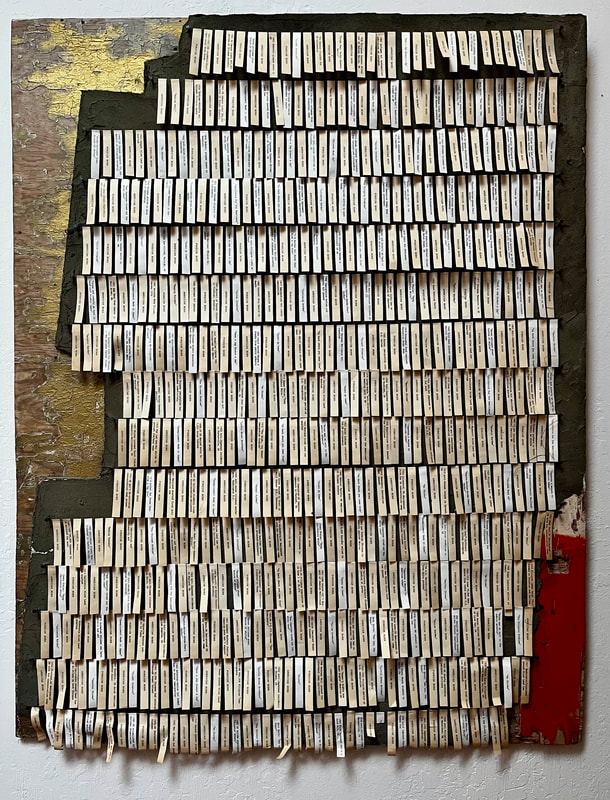
4. Missed Fortunes, 1994, mixed media on upcycled wood panel, 45.5 x 36   

A memorial to Asians in America who have been victims of anti-Asian racism, hatred and violence since the early days of immigration. Slips of paper reminiscent of paper fortunes hang horizontally on delicate wires of tarnished “gold”, the original attraction of early sojourners to “Gold Mountain.” However, the writings on each slip are not fortunes but instead racial slurs or actual dated incidents of hate crimes perpetrated against Asians. Other slips say “American Born” or “Foreign Born,” to suggest how Asians are “lumped” together in the U.S., indistinguishable by appearance. Sadly the same vitriol and hatred continues today towards other immigrants of color, as evidenced by hate speech being strewn by many of those in positions of power. The current additions to this piece are easily recognized quotes coming from the Prez of the USA and names of those killed by ICE, hanging on a fake gold wire, of course.
 
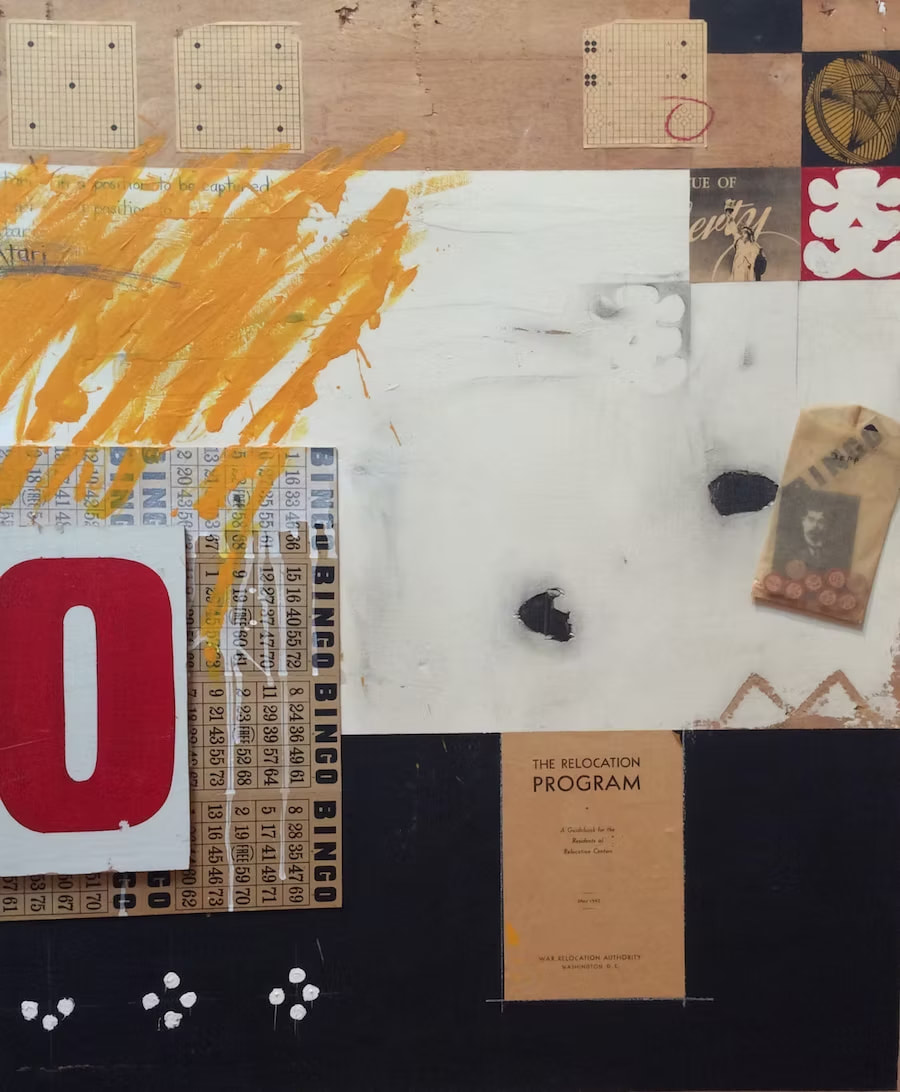
5. Game of Go, 1995, mixed media on upcycled wood panel, 36 x 30

Dedicated to my paternal grandfather, Kiroku Bepp. One of his pastimes while incarcerated at Heart Mountain camp was playing the Japanese board game called “Go”, a game of intense strategy, attacks and counter attacks, like those used in war. I incorporated this metaphor to refer to how the US government used various strategies to round up the Japanese and put them away, like pawns in a game. I also mockingly refer to other games such as Bingo and Atari. The word "atari" in Japanese references a position in the Go game when a group of stones is imminently in danger of being taken by one's opponent.

6. Heart Mountain Anonymous, 1995, mixed media on upcycled wood panel, 48 x 14

This is an anonymously written "poem" that my parents brought back from Heart Mountain concentration camp carved into a piece of found wood. The Japanese character on the top means “person or individual” and the bottom means “full house”, referring to a theater that is full of people:
Each stands only by help of the other.                    
  One by itself cannot stand. Without help
  one person cannot live in this world; but
  by getting help and giving help everybody
  can live. If nobody helped anybody, all
  people would fall down and die . . .

7.  and 8. Freedom’s Touch Series, Kiroku Bepp, 12 x 12  & Celia Miyo Bepp, 12 x 11, mixed media collage: handmade paper, vintage Japanese textiles, leaves, sashiko hand-stitching, 2024
        
This is part of a series of collage portraits honoring my grandparents and my sister who were incarcerated in the American concentration camp in Heart Mountain, Wyoming during World War II. These photos were taken while they were imprisoned from 1942-1945 and are a symbolic portrayal of their resilience and grace. Although they had lost their freedom, each piece focuses on their humanity and courage.
My materials signify their connection to the earth and to their culture – I combine handmade papers, handwritten notes, vintage Japanese textiles, dried leaves and traditional Japanese hand stitching called sashiko. The loose embroidery threads symbolize unfinished business and a sense of upended ness. These portraits are a call for justice and a reminder to stand up for those whose voices continue to be wrongfully silenced.

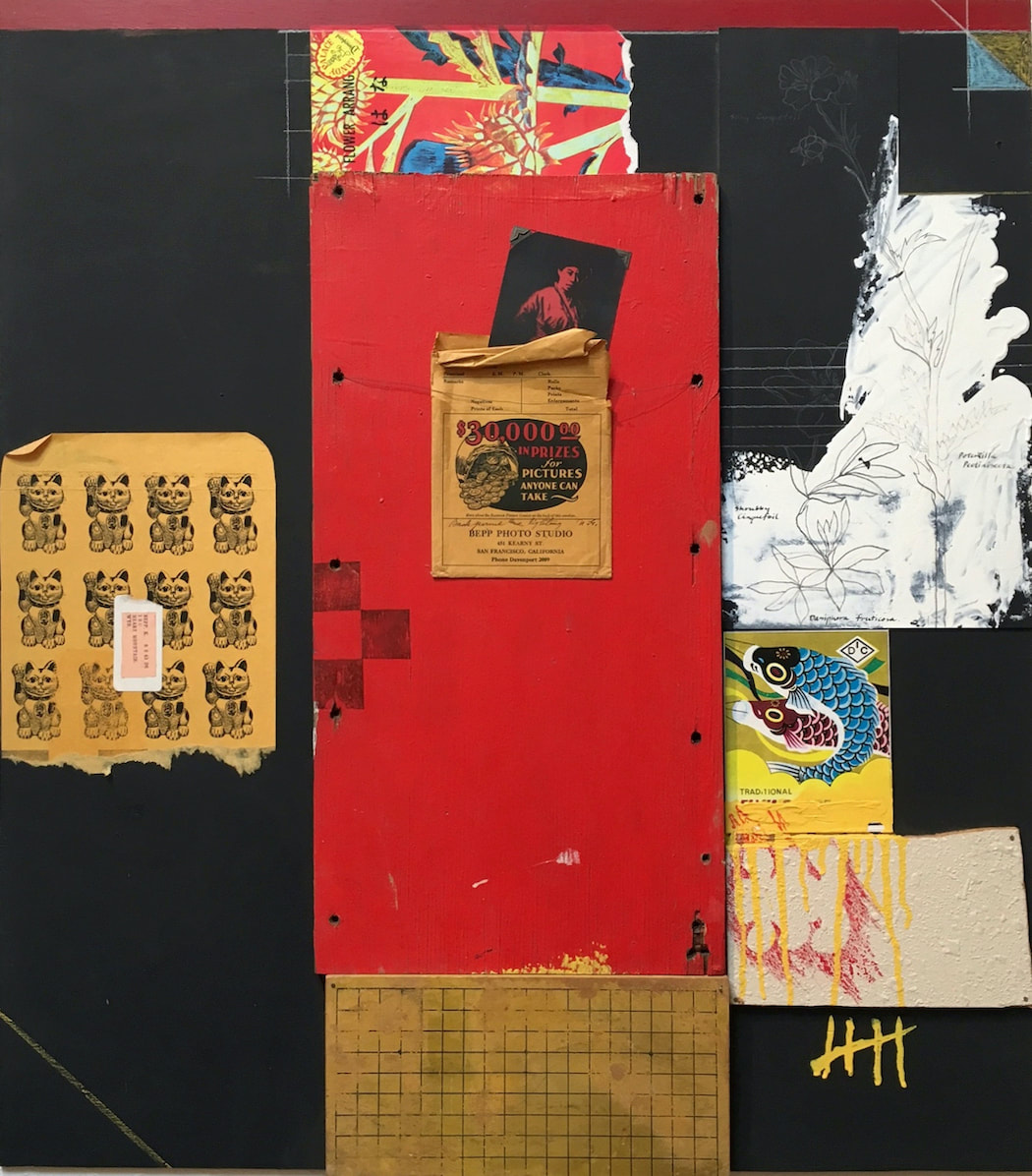
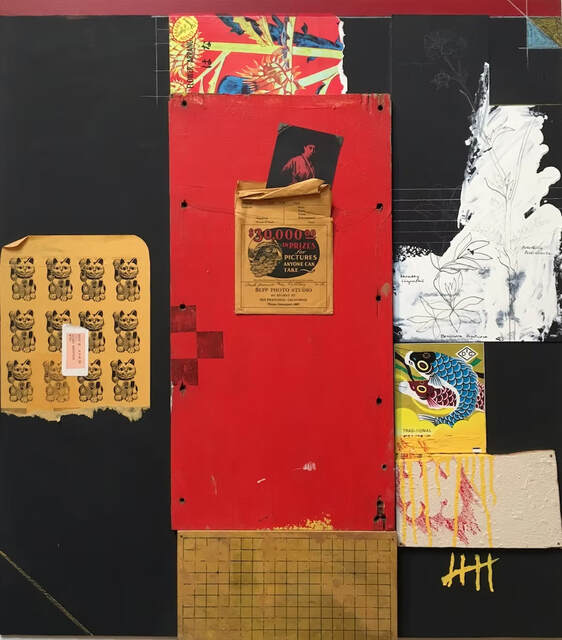
9. Sumi Bepp, 1995, mixed media on upcycled wood panel, 32 x 30 

Dedicated to my paternal grandmother, Sumi Bepp, an issei (first generation Japanese) artist, kimono designer, seamstress, flower arrangement teacher and one of my art inspirations. The images in this piece suggest memories of her life before going to the WWII Heart Mountain camp in Wyoming: Japanese folk art, the beckoning cats and the "koi" fish banners. The drawings of plant life refer to the only plants that could survive in the barren desert where the camp was located.
​
10. Targets, 2022, hand-embroidered and quilted Japanese cotton textiles 

This piece mimics the formal style of a traditional Japanese hanging scroll. The title refers to targets during war, specifically during WWII in the form of the bombings of Hiroshima and Nagasaki, Japan or targets of Japanese and Japanese American civilians who were arrested and imprisoned in the United States.
I started at the top by using a rather staid design of pieced Japanese woven and dyed fabrics and Japanese embroidery work called sashiko. But gradually I juxtapose that against the subject matter of death, destruction and injustice: a rendering of “Little Boy” which was the codename of the type of atomic bomb used in the bombing of the Japanese city of Hiroshima on Aug 6, 1945. That is followed by text highlighting some of the terminology used at the time to describe the horrors of these actions followed by the names of the 10 US WRA concentration camps. The final lines of text are of the Pledge of Allegiance, incomplete, and ending with a single thread trailing off and abandoned just as Japanese Americans were forcibly

Woman with short dark hair and glasses standing next to a trunk with an artwork shaped like a happi hanging above it.
art work wit strong red central element, Japanese papers glued on, image of an asian style fish drawing on the right
Upcycled wood panel with dozens fo fortune cookie fortune slips referencing the Japanes incarceration camps, slurs commonly used for people of Asian decent and actions taken by the US Government to restrict people of Asian decent to the camps as well as statements of ICE actions
the remains of an Asian-style shoji panel, a weathered chunk of a wall with continuous lines of text: racist quotes from early history books describing anti-Asian hatred and xenophobia in America, poems of despair by Chinese immigrants carved into the cell walls at Angel Island Detention Station and quotes describing traumatic experiences of racism in the U.S. In the background loom images of rows of barracks at a WWII American concentration camp, and another reminder to heed the “writing on the wall”
TRANSMISSION GALLERY 
OAKLAND

​770 West Grand Ave., Suite A,
Oakland, CA 94612

​
Open Thurs-Sat, 12 to 5 pm
​and by appointment
Closed Dec 25 and Jan 1

Accessibility:
This a 2nd floor art gallery, accessible by stairs

​Transmission Gallery Newsletter Signup
Picture
  • Exhibitions
    • Ellen Bepp: The Ghosts We Carry
    • William Rhodes: Fear Not
    • Peter d'Agostino: World Wide Walks / SFBay
    • Gallery Showroom
    • Past Exhibitions Oakland
      • Donald (Aldo) Farnsworth: Hands of the Maker
      • Daniel McClain: Lost and Found
      • Cate White: World Raw
      • M. Mark Bauer: THE, THE
      • Jeff Dikio: This Must Be the Place
  • Events
  • News
    • Satellite Projects
  • Collect Art Online
    • Painting
    • Drawings
    • Prints
    • Sculpture
  • Artist's Opportunities
  • Artists
    • Robin L. Bernstein
    • Karl X. Hauser
    • William Rhodes
    • Sachiko Miki
    • Jeannie O'Connor
    • Dave Yoas
  • Contact
  • Visit